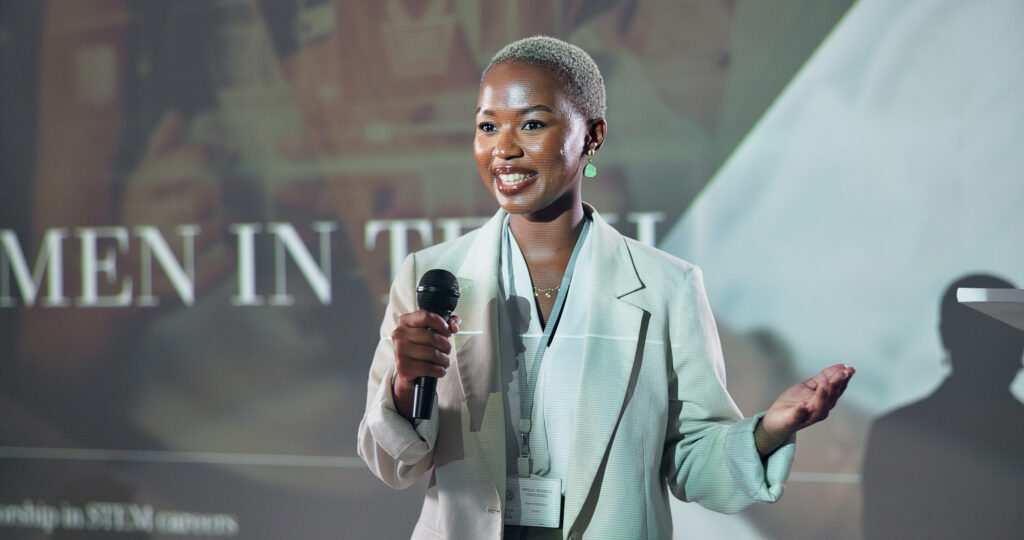
You stand up to speak. You know your subject, and you have something useful to share. Then you become aware of everyone looking at you.
Your attention turns inward. You notice your hands. You listen critically to your own voice. You wonder how you compare with the person who spoke before you.
Perhaps you rush. Perhaps your voice becomes smaller. Perhaps you fill every pause because being watched in silence feels uncomfortable.
This is where I begin when we work on executive presence: taking up your space, trusting yourself and staying connected to the people in front of you.
What is executive presence?
In my coaching, executive presence means bringing assurance, attention and a sense of purpose to the way you speak and listen.
You might experience it as feeling able to stand in front of an audience, take a moment and begin. Or to remain engaged when a senior colleague asks an unexpected question.
There is room for warmth, humour and quietness within that presence. Your personality belongs in your communication.
These skills are useful whenever you need to be heard, whether you are delivering training, presenting your work or contributing to a discussion.
Public speaking and energy management
I often say to the people I work with that improving public speaking is largely about energy management: learning where to place your attention and how to use your energy to connect with an audience.
Where does your attention go when you speak?
If you are checking how you sound, anticipating judgement or comparing yourself with somebody else, it can become difficult to stay with what you are saying and the people you are saying it to.
Actor training gives us a practical way to explore this. An actor works with an intention: to reassure someone, persuade them, challenge them or help them understand something. That purpose gives their attention a direction.
You can apply the same principle to a presentation.
Before you begin, ask yourself: What do I want these people to understand, feel or do?
Give yourself a specific purpose, such as helping colleagues understand a change or reassuring a team about the next step. As you speak, practise returning to that purpose whenever you notice your attention drifting into self-criticism.
Recognising and directing your energy
Developing executive presence involves recognising your energy and learning how to adjust it to the situation.
For you, nervous energy might show up as rushing, restless movement or tension in your voice. You might also respond by holding yourself very still and losing some of your natural expression.
In coaching, we explore what happens for you and practise useful adjustments. These might include finding a comfortable, supported position, releasing unnecessary tension, allowing an easy breath or warming up your body and voice.
Energy management also includes finding the animation your message needs.
There are moments when you need to settle. There are others when you need more physical engagement, vocal variety or willingness to express your interest in the subject.
You can be grounded and lively at the same time. The aim is to make your energy available for the conversation you want to have.
Taking up space and receiving attention
Taking up space includes giving yourself permission to be seen and heard.
It can mean allowing your voice to reach the room, finishing a thought without hurrying, or giving yourself a moment to respond to a question.
For some people, simply allowing an audience to listen is something to practise. They are comfortable with their knowledge, yet feel exposed when everyone turns towards them.
This is where self-trust becomes practical.
You rehearse standing or sitting comfortably while you speak. You practise allowing a pause. You discover that you can lose a word, find another and continue.
You also practise listening, so that your attention can move between your own purpose and what is happening in the room.
Those experiences give you something concrete to draw on the next time you speak.
An exercise to practise executive presence: finding Second Circle
Voice teacher Patsy Rodenburg explores three circles of energy in her book Presence. Here is a short practical adaptation of that framework.
Try it with a willing partner, using the same sentence each time: “I’d like to share an idea with you.”
- First Circle: attention inward. Let your posture close in slightly and lower your gaze. Say the sentence with your attention on yourself, allowing the words to retreat towards you. Notice how little connection you make with your partner.
- Third Circle: energy beyond the listener. Expand your posture and gestures. Deliver the sentence as though addressing a point beyond your partner, letting your attention pass over them. Notice the difference between being expansive and connecting with this particular person.
- Second Circle: connection and exchange. Settle into a comfortable, upright position and allow an easy breath. Meet your partner’s gaze naturally and speak directly to them. Let them reply, listen fully and allow their response to affect you.
Ask your partner how each version felt, then repeat the Second Circle exchange.
This is the quality I associate with executive presence: being grounded in yourself while remaining available and responsive to others. You take up your space and meet the person in front of you.
Developing executive presence through actor training
As an actor, voice artist and communication coach, I bring work on attention, energy, voice and physical presence into my coaching for professionals.
We use the situations you actually face: an upcoming presentation, a training session, a meeting or a conversation in which you want to feel more assured.
Together, we explore how you can trust your expertise, take up your space and connect with the people listening.
If you would like to develop your executive presence, explore my public speaking coaching for professionals and book a free 15-minute phone consultation. We will talk about what you find challenging and what you would like to change.